
This is Part Two of a long-form article that highlights why practitioner-focused research is needed in the impact incubation industry. In Part One, we looked at recurring challenges in the field, such as incubators'Incubator' refers to any organization whose programs primarily focus on vetting and selecting, promising social enterprises, and providing them with a comprehensive range of support services aimed at building and growing them to achieve maximum sustainable impact. facing funding uncertainties and donors rethinking how they define success. While each story is unique, together they show a sector at a turning point. Entrepreneurial Support Organisations (ESOs) play a vital role in the entrepreneurial ecosystem, but often lack clear evidence about what makes their models strong and effective. Read on to see how Pollinate Impact is addressing these challenges and why collective inquiry matters.
We view these stories as starting points for deeper inquiry, not just anecdotes. Each pattern and tension we notice suggests the ecosystem is ready to learn and change. To do this, we need to move beyond intuition and focus on evidence that practitioners help create and interpret.
A Field Built on Questions
Our research agenda starts with a simple but ambitious idea: the people building the field know best what needs to be understood. Over the past two years, through conversations with members, partners, and in group sessions, five main themes have come up as priorities for collective exploration. These themes are not strict categories, but ways to better understand how ESOs grow, adapt, and sustain their missions.
1.Financial Sustainability of Impact Incubators
Incubators'Incubator' refers to any organization whose programs primarily focus on vetting and selecting, promising social enterprises, and providing them with a comprehensive range of support services aimed at building and growing them to achieve maximum sustainable impact. and accelerators in the Global South often face a balance between their mission and financial needs. The main question now is not if funding is limited, but which types of funding help build long-term resilience. In this theme, we will examine how diversified revenue sources affect stability, the current donor landscape, and whether co-creation with funders will lead to healthier, more empowered incubation models. We also want to explore the power dynamics between donors and incubators'Incubator' refers to any organization whose programs primarily focus on vetting and selecting, promising social enterprises, and providing them with a comprehensive range of support services aimed at building and growing them to achieve maximum sustainable impact. to better understand how trust and transparency can transform this relationship from a transactional to a genuinely collaborative one.
2. Cooperation Between Impact Incubators
The field’s overall strength relies on how well its members connect. Many incubators'Incubator' refers to any organization whose programs primarily focus on vetting and selecting, promising social enterprises, and providing them with a comprehensive range of support services aimed at building and growing them to achieve maximum sustainable impact. operate independently, sometimes duplicating efforts or competing for the same opportunities. This theme explores the value of collaboration:
- Do stronger networks lead to greater trust, efficiency, and learning?
- How valuable are existing ESO networks such as AfriLabs, ASSEK, and ISBA?
- What are the best approaches to co-incubation and shared resource models?
With this focus, we will examine how learning from peers and partnerships between incubators'Incubator' refers to any organization whose programs primarily focus on vetting and selecting, promising social enterprises, and providing them with a comprehensive range of support services aimed at building and growing them to achieve maximum sustainable impact. can accelerate growth for both organisations and the wider ecosystem.
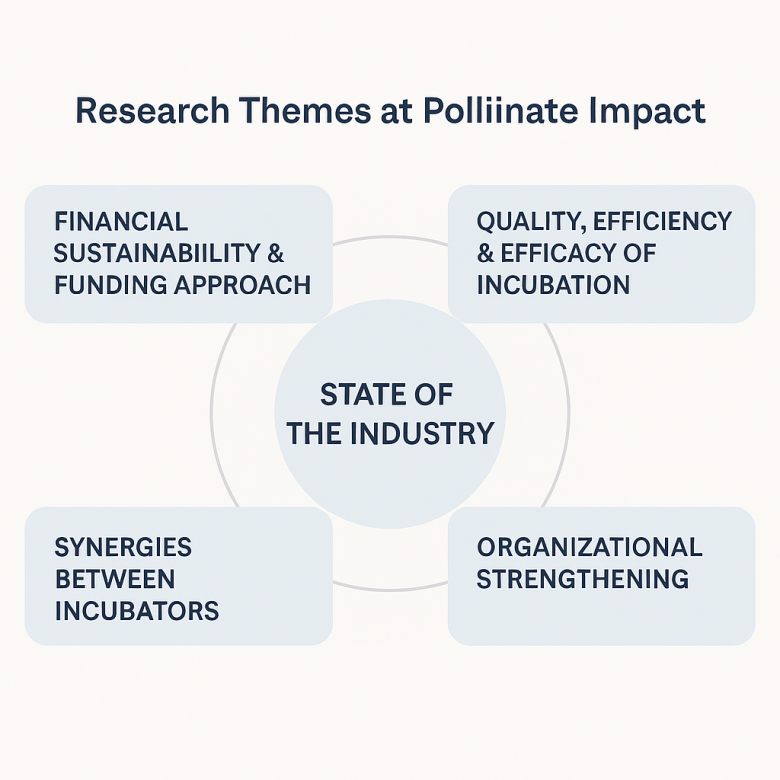
3. Quality, Efficiency and Efficacy of Incubation
People often talk about “effective incubation”, but it is rarely clearly defined. What really works, and what does it cost? In this section, we will examine best practices and scaling models that help ESOs grow their impact without sacrificing quality. We will also ask what standards exist for incubation and whether there should be any. By looking at the real costs of incubation across different places and sectors and considering what the future might hold, we hope to build a shared understanding of what works, grounded in evidence rather than assumptions.
4. State of the Impact Incubation Industry
The impact incubation sector has grown rapidly, but remains unevenly understood. In this theme, we will review where the field is now, especially in the Global South, where models and ecosystems differ significantly.
- What policies and enablers accelerate impact incubation?
- How active and diverse are local ecosystems, and what can we learn from them about adapting and innovating?
By mapping the state of the industry, we aim to provide a starting point for strategy and policy, not as a static snapshot, but as a reflection of a changing field.
5. Organisational Strengthening
Finally, we turn inward to the institutions themselves. The long-term success of incubation depends not only on funding or strategy, but also on strong internal systems and leadership. This theme explores whether improved governance, flexible funding, and improved processes lead to more effective incubation. It also examines how incubators'Incubator' refers to any organization whose programs primarily focus on vetting and selecting, promising social enterprises, and providing them with a comprehensive range of support services aimed at building and growing them to achieve maximum sustainable impact. attract, retain, and motivate people, and how planning for leadership transitions can help organisations endure. In short, what makes an incubator'Incubator' refers to any organization whose programs primarily focus on vetting and selecting, promising social enterprises, and providing them with a comprehensive range of support services aimed at building and growing them to achieve maximum sustainable impact. strong on the inside?
Taken together, these five themes show the shared curiosity of our network and the wider ecosystem. They are questions that practitioners keep asking, funders want to explore, and researchers can help turn into shared learning.
Building the Research Practice
Turning these questions into evidence requires a structure that is both rigorous and flexible. This is why our research is focused on developing a practitioner-driven research approach, inviting those working directly in incubation to help create and shape the process.
Our approach draws on a mix of complementary methods, each designed to capture different parts of the real-world experience:
- Surveys to establish sector-wide patterns and baselines across our membership,
- Targeted interviews to surface depth, nuance, and lived experience,
- Cohort pilots to test ideas in small, collaborative groups before scaling learning,
- Case studies to document diverse models and lessons from the field,
- Participatory workshops where practitioners themselves frame and validate emerging insights, and
- Researcher partnerships that connect academic curiosity with practical field questions.
By combining these approaches, we aim to generate research that practitioners can use right away. This could help them refine their business models, strengthen their internal systems, or demonstrate value to funders. The emphasis is on applicability: evidence that can travel from a whiteboard to a work plan.
Grounded, Collective, and Useful
Too often, research in the development and incubation ecosystem is mostly theory— interesting to read, but difficult to act on. Our research practice is designed to close that gap. Our job is not just to gather information, but to turn real-world experience into insights that help the field.
We see this as a cycle: practitioners raise questions, research captures and analyses patterns, and then insights return to practitioners as tools, frameworks, or benchmarks. These insights spark new questions. Over time, this creates a learning loop where knowledge continuously improves practice.
Already, through discussions with our members, we’ve seen early examples of this in action. Incubators'Incubator' refers to any organization whose programs primarily focus on vetting and selecting, promising social enterprises, and providing them with a comprehensive range of support services aimed at building and growing them to achieve maximum sustainable impact. are collaborating on new funding models, sharing training resources, and using data to assess program quality. These are early signals that the field is beginning to study itself—not as a compliance exercise, but as a pathway to collective strength.
A Commitment to Care
Every research process begins with trust, and trust begins with care. As we collect data and stories from across the ecosystem, we are very aware of our responsibility to handle this information ethically and securely.
All data shared with Pollinate Impact will be kept confidential and handled with great care. We are committed to protecting participants’ information and to using it only for the reasons it was given. We also intend to work transparently, sharing our frameworks, questions, and findings openly so that others can build on them.
This is how we hope to cultivate a research culture that feels safe, inclusive, and genuinely collaborative. Our goal is to take, but to share and exchange.
Looking Ahead: A Shared Research Journey
Right now, we are focusing on one of the most pressing questions for the field: The Financial Sustainability of Impact Incubators'Incubator' refers to any organization whose programs primarily focus on vetting and selecting, promising social enterprises, and providing them with a comprehensive range of support services aimed at building and growing them to achieve maximum sustainable impact. and Accelerators. We are currently conducting a primary study to understand how these organisations sustain themselves, diversify their revenue, and plan for resilience in uncertain funding environments.
But this is just the beginning. Each of the five themes we have identified will evolve through dialogue, experimentation, and collective interpretation. In the coming years, we envision a research practice that becomes a shared resource—a place where evidence grows through contribution rather than competition.
An Open Invitation
If you are an Impact Incubator'Incubator' refers to any organization whose programs primarily focus on vetting and selecting, promising social enterprises, and providing them with a comprehensive range of support services aimed at building and growing them to achieve maximum sustainable impact. or Accelerator and would like to contribute to this collective inquiry, we invite you to participate in our ongoing primary research on Financial Sustainability.
You can begin by filling out our short pre-survey form.
By taking part, you will help build a stronger base of evidence for the field—one that reflects not only the challenges we face but also the creativity ESOs use to overcome them.
Together, we can move from isolated stories to shared understanding—and from understanding to action that strengthens the whole ecosystem of entrepreneurial support.

Himakshi Chaudhary is the Research Weaver at Pollinate Impact. Based in Delhi, she leads efforts to strengthen data and insights across the impact incubation field. She brings experience across research, sustainability, and development, combining analytical thinking with a storyteller’s instinct to turn insights into action. Outside work, she’s a trained Hindustani classical singer who finds joy in poetry and badminton.